

Topic 7 : Relationship with Social Networks and Screens among Teens aged 12 to 17
For English subtitles, click Settings, Subtitles, and select English.
Public-health specialists in Quebec and around the world are very concerned about the impact of screen use and hyperconnectivity on the development of children and adolescents. The impact can be seen on:
- Mental health: low self-esteem, anxiety, depression, stress, inattention, and hyperactivity, etc.
- Physical health: sedentary lifestyle, overweight, lack of sleep, visual impairment, posture problems, etc.
- Social life and interpersonal relationships: isolation, diminished social skills, safety risks, etc.
Starting point: Being a good role model
The role model you offer your teens is the foundation of their learning. It's important to question your own use of screens in your life and in front of your children. Here's some food for thought for you:
- Do you check your cell phone as soon as you wake up in the morning?
- Do you often check your e-mail or text messages when your child is present?
- Do you manage to put your cell phone away when spending time with your family or attending one of your child's activities (e.g., a soccer game, a soccer tournament, etc., : soccer game, music show)?
- Do you look at quality content useful in your daily life?
So, are you a good role model for your developing teenager?
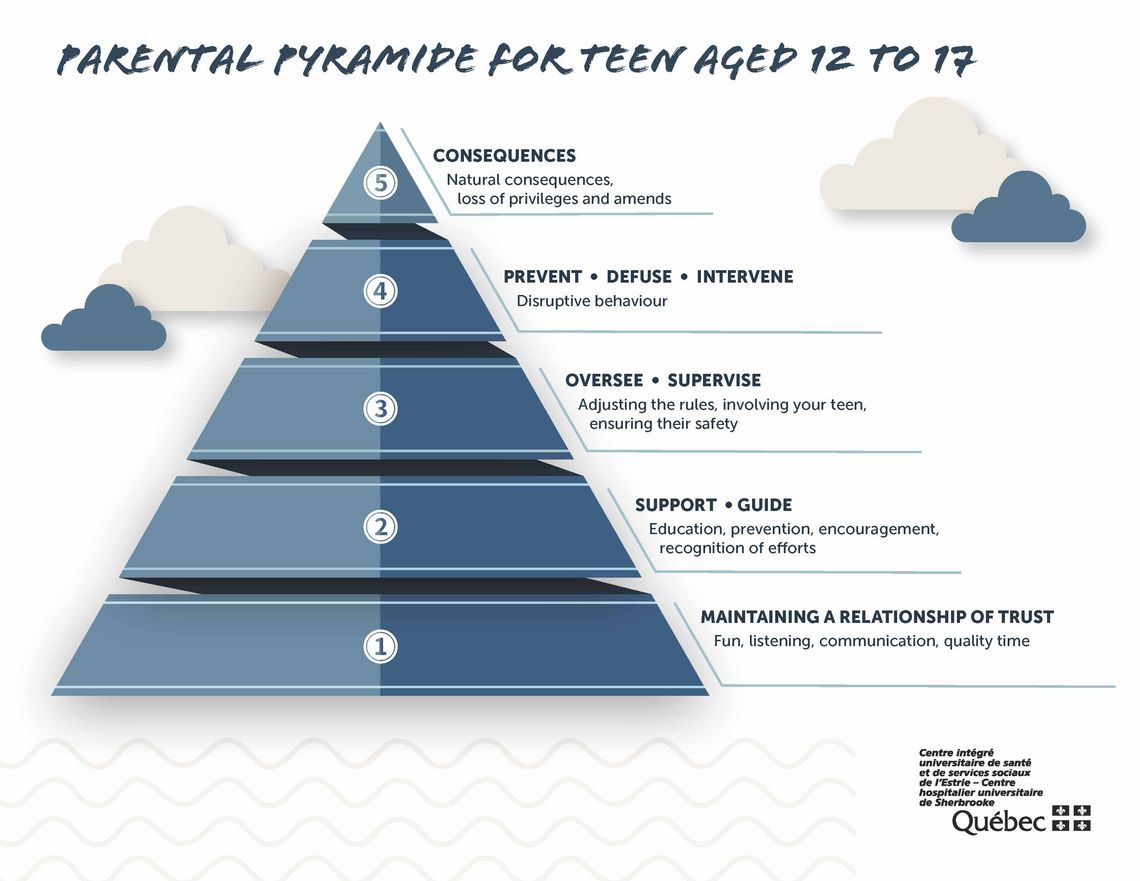
1 - Maintain a relationship of trust
It's perfectly normal to be tempted to look at your social networks, start an online game, or research a topic you have in mind. Tell them about your experience and that many people are going through the same thing. It's precisely because screens have such a powerful attraction that steps must be taken to keep control of them.
What you can do to get closer to your teen:
- Find out about your teen's friends and activities on social media and electronic games. Make it a discussion, not an interrogation.
- Ask how the applications they use and the games that interest them work.
- Discuss the benefits and risks of using screens and social media to promote safe use.
- Discuss online behavior and how to respect themselves and others.
2 - To assist and support
Your teen needs to gradually integrate what's right for them when it comes to online activities. This will motivate them to do the right thing. Here are a few questions to ask your teen to help them develop critical-thinking skills.
- What do you think are the advantages of consulting…
- How do you feel when you take part in…
- How do you think the person you wrote this to feels?
- How does using the Internet and social media help you keep in touch with your friends, and how can it harm you?
- What do you think is safe screen use?
- Why do you think it's hard to control your screen time?
Social media: hard on body image
We know how fragile a young person's image is as it develops at this age. For tips on how to help your teen distinguish between what they see on social media and in real life, please use the following link.
3 - To manage and supervise
It's all about BALANCE!
Limited time – quality content – appropriate timing
Limit screen time
It's a good idea to set a specific time for screen use in your family routine. This will encourage your teen to get involved in other activities that will enable them to develop different skills. Your teen will also learn how to stop, even if it's fun!
Here is an example of limits you can adopt in your family routine for your teenagers ages 12 to 14.
- Weekday mornings: Maximum of 30 minutes of television when the morning routine is over. You can even specify the type of content during the week. For example, educational content only or a TV series in French if you want them to learn the language.
- Weekday evenings: Maximum one hour of screen time—all devices combined—and educational content.
- Weekdays: Ban on video games except on special occasions. This gives you a gateway to adding a reward when appropriate!
- Days off: Maximum one or two hours in the morning, starting at 7 a.m. (so they don't get up too early to head right for the tablet). Content of their choice that you take the time to supervise. If the day goes well, they could also be allowed a maximum of one hour's screen time at the end of the day.
Involve your teen in this family agreement. They can contribute ideas or choose content depending on their age. Remember, parents makes the final decision.
Teens aged 15 to 17 - depending on their level of maturity and development—will be able to manage their screen use more independently. That doesn't mean you should adopt a laissez-faire attitude as a parent. Instead, we invite you to continue discussing their online activities and interests with them.
Supervise
Of course, it's not enough to make rules: you also have to apply them. That requires parents to take the time and be available. Supervise, monitor, and intervene when your teen doesn't follow the rules. Handle tantrums if need be! Refer to the preferred interventions for managing your teen's emotions.
Last but not least, it is strongly suggested that you include privileges and consequences related to your teen's collaboration.
To ensure that your young people looks at quality content at the right time:
- Request their access codes.
- Switch off Wifi at set times.
- Check the history of sites visited.
- Install parental controls.
- Encourage your teen to use their electronic devices in a common room.
- Don't do all this behind their back. Your teen needs to know that you're supervising them.
Vigilance
In recent years, cases of child sexual exploitation on the Internet have increased significantly. This confirms the importance of prevention, education, and parental supervision for our young people. The strategies developed by predators are increasingly sophisticated and attractive to young people as they begin using the digital world. The victims are getting younger and younger.
Fortunately, there are resources available to help you:
- Canadian Centre for Child Protection
- Fondation Marie-Vincent
- CAVAC network or 1866-532-2822
- Your local police department or Info-Social 811
Encourage zero-screen moments and suggest activities
Make it a family challenge, with everyone in the household taking part!
- Digital-free day once a week
- Screen-free zone in the home, like at the kitchen table.
- Technological curfew one hour before bedtime: Give parents the technological tools to prevent teens from using them during the night. You can have a basket or a place set aside for that.
- Turn off your cell phone, leave it in a room, and avoid carrying it always with you.
How social skills fit in!
How to use technology without neglecting social-skills training and the priority of social contacts.
- For example, when you're with friends or someone is talking to you, put down your camera and look at the person talking to you.
- Sometimes insist on social activities for your teen. This involves moving about somewhat, but it's a very good cause!
Separated parents
Agree on the rules. One parent might not allow the console or cell phone to go home, but it's up to you to discuss this clearly and respect everyone's choice.
4 - Protect, stop and react
Does your teen react intensely when you turn off the screens?
The longer you delay setting up a clear framework and limits at home, the stronger their reaction will be when you do. This reaction could be due to:
- Your teen having trouble in managing emotions.
- Screen addiction is on the rise, given the amount of time spent in front of screens in recent years. Stopping could make your teen very anxious and create real distress. They might not know what to do other than online and may have lost their bearings.
Tips:
- Go gradually by progressively reducing screen time and accompanying your child in cultural, social, and sporting activities. It will take up a lot of your time, and that's important. The idea is to find interest and motivation away from screens.
- Give them some heads-up before turning off the screen (e.g., "We're shutting down in 10 minutes") so they can get ready and finish what they've started. This predictability helps reduce explosive reactions!
- Help your teenager develop self-control by allowing them to gradually manage their screen time on their own, and by warning them only if they exceed the limit.
- Your supervision is required. Go one step at a time at first. Your teen needs you to take care of them so that they can take care of themselves.
5 - Consequences
Empowering your teen in their choices means allowing them to experience the consequences of and unpleasantness related to an inappropriate choice.
- Don't hesitate to take away screen time if they refuse to stop when the time is up.
- In the event that they have made an inappropriate online gesture resulting in a complaint, guide them through the process and let them deal with the consequences on their own: excuses needed, work to be done, explain their point of view to the person concerned, etc.
Avoid defending their mistakes. It's normal for teens to make mistakes, but they simply have to learn to accept them in order to grow up and take responsibility.
If your teen needs support for screen overuse, consult the following organizations:
- Local CLSC (psychosocial support)
- Center de réadaptation en dépendance de l'Estrie (formerly Jean-Patrice Chiasson)
- Family doctor
 Go to capsule 8
 Return to patway's home page