

Topic 5: Socialization of Adolescents
For English subtitles, click Settings, Subtitles, and select English.
The social aspect is a very important part of your teenager's life. They seek out different opinions, points of view, and experiences that will help shape their own personality and identity.
What's more, significant friends will help them overcome the various challenges of adolescence by being sources of comfort and providing important emotional support. Young people who have meaningful relationships with their friends report fewer symptoms of distress, anxiety, and irritability.
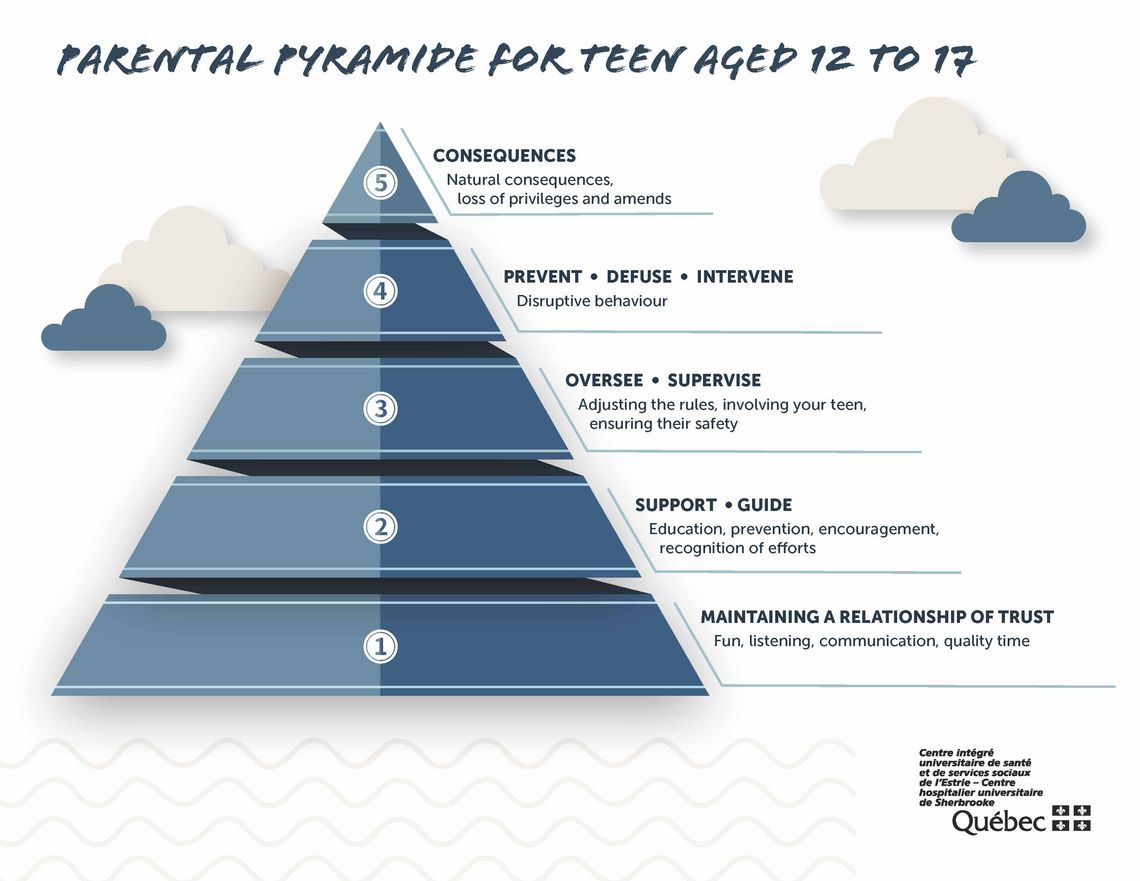
1- Maintain a relationship of trust
The relationship evolves as your child reaches adolescence. A certain distance and boundaries are established without detracting from the quality of your emotional bond. This distance is completely normal and allows your teen to feel free to experience new things and develop new relationships.
Your teen needs to feel that you're allowing them to distance themselves.
- Take a positive interest in your teen's relationships without making it an interrogation.
- Discuss their activities with friends, even if your teen doesn't have the same tastes as you. Try to accept your teen's choices, instead focusing on the reasons behind them.
- Choose a good time to talk with your teen.
- Respect their choice not to talk to you about it. Teens need to keep things to themselves, to have their secrets.
2- The importance of social skills
The quality of our interactions and relationships is greatly influenced by our social skills:
- The capacity to manage your emotions and stress
- Communication skills (asking for help, assertiveness, listening)
- Decoding other people's emotions, empathy
- Conflict-resolution skills
Here's how to help your teen to make friends and develop their social skills.
- Encourage your teen to participate in extracurricular activities, which allow them to get involved in a group of like-minded peers.
- Offer to volunteer for a cause close to their heart.
- Be open to them inviting their friends over, as this allows you to get to know your teen's network and create a bond with some of their friends. It's also a great opportunity to observe your teen's social skills! IMPORTANT: Talk it over with your teen in a caring, nonjudgmental way. Above all, wait until they are alone and not with their friends present.
What if you disagree with your teenagers's choice of friends or social activities? That can happen because you don't have the same needs and goals as your teenager.
| Parent's objectives for their teenager: | Teen's objectives | ||
|
|
What you need to avoid above all are judgments and criticisms that come from your perception as a parent:
- "He's not a friend for you."
- "This choice of activity will get you nowhere."
- "Is that anyway to dress?"
Instead, get them to understand their choices. You can help your teen become aware of their emotions within their social experiences. This will help your teen recognize what's important to them.
- What do you think will happen if you make this decision?
- How do you feel when you're with this friend and doing this activity?
- Do you think it's good for you in the longer term? What's in it for you?
You can help your teen recognize the signs of a negative influence or a bad friendship:
- an accumulation of disappointments and disputes
- manipulation
- jealousy
- lack of respect
- revealing secrets
- pressure to do things against their will, etc.
3- Supervise for predictability and security
While it's important to let your teen have social experiences, they still need the framework and limits you'll negotiate together. You have little control over your teen's choice of friends, activities, or interests. You do, however, have some control over the following:
- The house rules when your teen invites friends over (respect for others and the environment).
- Rules governing outings (say where they are, agree on curfew).
- Budget you want to give them for activities.
- Find out if there will adults are present when your child goes out.
- Make sure your teen knows how to reach you if necessary.
- Refuse to let them take part in an activity that jeopardizes their safety.
4- Prevent, defuse, and intervene in disruptive behavior
Does your teen hang out with friends who have a negative influence on and get caught up in problematic situations (vaping, drug and alcohol use, theft, vandalism, etc.)? Here's how to react:
- Approach the subject by expressing your own concerns (avoid judging or preaching).
- Identify your reasons for doing so (needs).
- Discuss with your teen the contexts in which influence would be hard to resist.
- Help them identify the positive and negative consequences of their choices.
- Help them find ways to assert themselves in situations in which they feel uncomfortable.
- Make sure your teen knows the consequences of breaking the law (bullying, violence, vandalism, sharing intimate photos of someone, etc.).
Refer to their positive experiences. Highlight their emotions when they are a positive role model within a group.
5- Apply a consequence, if necessary
Does your teen have to live with the consequences of their choices?
- Empowering your teen means getting them to assume their responsibilities in the situation. Some examples are apologizing, being honest and admitting they were wrong, and fixing what they've broken.
- What about when your teen tells you that it's not their fault or that it's their friends who have influenced them? This is a great opportunity to ask if they like that they have friends who influence them in this way.
- Don't use a moralizing or guilt-tripping tone. Just have an open, caring discussion about what's good for them.
Collaborate and support school and police decisions regarding resources and consequences. What if you don't agree with their decision:
- That's possible and you have the right.
- Important: Make an appointment with the person concerned to clarify the situation and express your disagreement without your teen being present.
If you're worried about what your teen is doing with their friends, fearing for their safety or that of others:
- Share your concerns with your teen.
- Contact the police, who can intervene in a number of ways, including the involvement of community police, who develop special ties with young people in certain neighborhoods.
- Call Urgence détresse by dialing 811, option 2, for immediate psychosocial support.
- The Aire Ouverte services are mandated to reach out to young people aged 12 to 25 that are difficult to reach. If your child refuses services or has difficulty taking part, you can contact Aire Ouverte to discuss options with a counsellor by calling 819-572-2473 or writing aireouverte.ciussse-chus@ssss.gouv.qc.ca.
- Report any concerns you may have to Youth Protection.
 Go to capsule 6
 Return to patway's home page